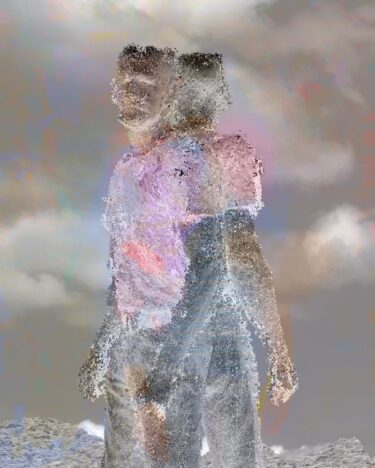
Simon Lehner: Father, Archive material 3D scan/rendering with incorporated archive images (early stage), 2005-2018, aus der Serie How far is a lightyear?, 2005-2019, C-Print, 90 x 72 cm © Simon Lehner

‘A chronicler who recites events without distinguishing between major and minor ones acts in accordance with the following truth: nothing that has ever happened should be regarded as lost for history’. (Walter Benjamin)
Would Walter Benjamin have still written this sentence from his fragmentary thesis On the Concept of History today? In a never-ending stream an entire generation of chroniclers is currently documenting its personal stories. More than ever before, in an age of AI-enhanced reproduction, we find ourselves surrounded by image and text, by comments, film clips, and photographs. Current events and personal states are recorded in equal measure. The ‘change-exhausted’ and crisis-ridden society (Steffen Mau) is divided and reacts emotionally. There’s a growing need to counteract this and – in view of the fragility of democracies, environmental destruction, rising violence, exclusion, and social disintegration – to offer something constructive in response. But what can we really know, prove, or say with images, particularly photographic ones? And isn’t it precisely these images that deepen the divide, that are the very medium of ‘fake’ and polarize us – in short, that stand between us?
The exhibition sets out to interrupt this cycle of ongoing self-reassurance. Projects by approximately 20 artists offer personal perspectives for creating a resonant space for their respective subjects. The works listen and learn from others (Emmanuel Levinas) – not as megaphones that drown out everything else, but by reflecting on how, beyond mere simplification, one can tell it in a nuanced and, yes, gentle way. The exhibition highlights social realities and lends them a voice in what are for the most part (micro)narratives. Because telling a story is ‘something formally different from demanding something’, ‘telling something is more fragile than announcing something, different than suing to attain something’ (Carolin Emcke). The fact that the concept of history plays a key role in regarding the present becomes clear in images in which the past flares up in the present, offering flashes of insight – upon which moments of resistance can emerge.
Curated by Maren Lübbke-Tidow